Leptex Master Plan, Part Two
Embodied AI: follow a fruit order as robots learn to account for human needs, commitments, and responsibilities, connecting confirmed arrangements to reliable work in the physical world.
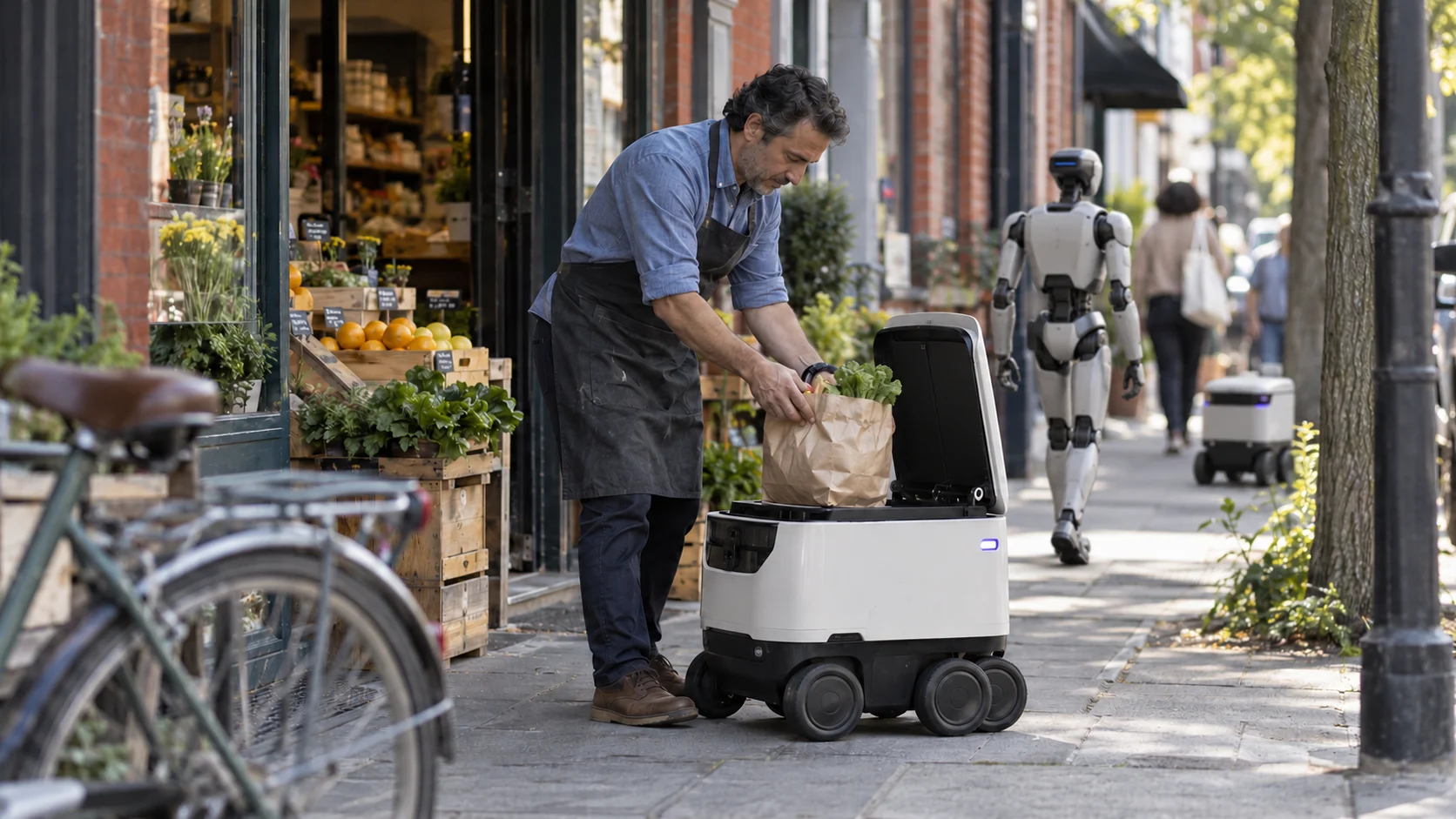
Continue the illustrative order from Part One. The customer has clarified the terms, and the farm has confirmed quantity and handoff arrangements. The phone can be put down for a moment, but work in the field continues. Fruit still needs harvesting, sorting, packing, and delivery under the agreed conditions. Once the terms are clear, someone still has to carry them out.
Now imagine a robot carrying a crate precisely to the collection point. If it carries the wrong order, acts on an unconfirmed change, or hands it to the wrong person, the commitment remains unfulfilled. A machine can be excellent at moving objects and still need more context to participate in people's work.
Part Two focuses on embodied AI: moving from understanding to action in the physical world. Intelligence interacts with its environment through machines that can perceive and act. For Leptex, each action needs to serve a human purpose: whom the work is for, what permits it to begin, when it should wait, and who accepts its outcome. These concrete requirements are what we mean by helping robots understand society.
That extends the boundary of Part One. Personal intelligence helps owners explain their businesses and handle requests. Physical coordination needs to keep confirmed conditions meaningful through to completion. We want an owner's experience eventually to guide a wider range of action without requiring the owner to explain everything again at each handoff.
Master Plan, Part One describes our existing knowledge, conversation, and order capabilities. Lucky Farm is our first onboarded merchant. Its hawthorn page presents products, prepayment information, and fulfillment terms; order availability follows the store's current status. Robotics, autonomous delivery, and forecasting across businesses in this chapter are future directions. They are not deployed at this farm and have no committed delivery date.
How operating conditions reach a machine
First, consider a handoff between people. An owner tells someone helping at the farm, "Keep this crate for the customer collecting tomorrow afternoon." The instruction identifies a customer, the goods, a collection time, and a commitment already made. The other person may ask where to put the crate or what happens if the customer does not arrive. Cooperation depends on a shared understanding of those conditions.
Those conditions still need expression when the work goes to a machine. A product photograph, conversation, payment result, and physical location each describe only part of the situation. The first task in equipment integration is to make the work explicit and let the owner inspect it.
Part One's software provides a starting point: organize information, make requests actionable, and distinguish confirmed terms. A farm need not have a complete sensor network to benefit from that work. Handoffs performed by people can become clearer first, with suitable machines participating later.
This route lets us see where the work is actually held up. If supply remains unconfirmed, adding transport equipment will not fix the problem. If conditions are clear and repeated transport consumes substantial time, there may be a specific automation task worth testing. Understanding the operation determines what to do first.
Turn an inquiry into an order that can be fulfilled
Leptex has already implemented merchant order review and payment workflows. After a customer expresses an intention to buy, the parties can proceed through ordering, confirmation, and payment according to the merchant's settings. The next step is to connect those existing capabilities more reliably to fulfillment in specific business settings.
Each step needs a clear, verifiable status. An inquiry, a quote, a confirmed order, a payment, and fulfillment represent different stages. A conversation alone does not establish an order. Successful payment does not establish stock availability or grant unrestricted authority to operate equipment.
Deeper fulfillment coordination needs to show owners which commitments exist and what work remains. When stock is insufficient, a pickup time changes, or a payment fails, the relevant steps also need to support pausing, reconfirmation, or refunds under the applicable conditions, avoiding continued execution of an incorrect instruction.
This stage translates human intent into bounded, checkable work. It can support operations performed by people today while laying a foundation for collaboration with machines later.
Imagine a customer postponing collection by a day. If the conversation says the change is accepted but warehouse or transport staff follow the original schedule, a friendly answer becomes a physical mismatch. We want future coordination to carry changes into the affected work, show the responsible people what needs reconfirmation, and tell the customer which changes have actually taken effect. This consistency is worth addressing before any equipment is connected.
A paid order cannot make unripe fruit mature sooner. Personal intelligence must accommodate physical limits: offer appropriate choices when supply is short, seek a new decision when conditions change, and update work from actual outcomes. Doing these things matters more than making a system say "completed" sooner.
Connect confirmed orders to the physical world
Imagine a future farm setting in which the tasks and equipment have been validated and people have harvested, sorted, and checked the fruit. Once the order and payment conditions are met, a transport task is authorized: move the corresponding crates from a specified location to a designated handoff point. The equipment reports arrival and any exceptions, and the relevant workflow confirms the handoff. An arrangement confirmed on screen is now connected to a completed piece of physical work.
We want to make this part of the workflow dependable first: confirmed requirements reach the site, results return to the owner, and people and equipment perform the work they are suited to. With sufficient field validation, we can assess more complex tasks such as sorting, harvesting, or delivery. The goal is for the customer to receive the fruit and the owner to see how the commitment was fulfilled.
The difficulty is that fruit is not data on a screen. Ripeness, fruit hidden by foliage, weather, damage, equipment failure, and food-handling conditions can change what is possible. Autonomous delivery must also meet the requirements of its particular route, handoff, safety conditions, and applicable rules.
Our proposed system would therefore not give a language model unrestricted, direct control of machinery. Order authorization, task scope, and equipment safety controls require separate validation. Equipment unable to complete a task reliably should stop and return it to a person. Conversation can express a need; constrained execution systems must carry out physical action.
Nor do we assume Leptex must manufacture every piece of hardware. Working with specialist equipment and delivery partners may be more appropriate than rebuilding their capabilities. Reliability, cost, and practical value to operators should determine what we build and where we partner.
In such a collaboration, Leptex aims to connect operating conditions, confirmed tasks, progress, and outcomes. Equipment partners would provide execution capabilities suited to the site; responsibilities for handoffs and maintenance among operators, merchants, and partners would need agreement before a pilot. Our product should let an owner see where an order stands and who handles the next step, progressively reducing the work of checking between separate systems.
This division also defines our scope. Validated specialist systems should handle movement, obstacle avoidance, and equipment safety. Leptex would concentrate on the connection between operating arrangements and execution outcomes. Where a partner already has a tool that does the job, we should connect to it. An additional software layer earns its place only by reducing handoff effort, omissions, or manual checking.
What should the first machine do?
Crate transport is one candidate. Choosing a first task should start with an owner's day: which job repeatedly consumes time, can its operating conditions be bounded, can the outcome be checked, and is suitable equipment already capable of doing it? A pilot is worth arranging only when those questions have answers. Where manual transport remains more suitable, that result should guide the choice.
This gives the owner a concrete way to judge what the machine contributed. It also helps the team locate failures. A crate that never arrives, arrives late, or reaches the wrong place presents different problems. Those results tell us whether to change scheduling, improve equipment, or retain human handling.
An initial pilot should deliberately change conditions: cancel a task after dispatch, make the handoff point unavailable, or interrupt the connection. The owner should be able to see which arrangement remains valid and which outcome is unverified, with independent ways to stop and handle the work on site. Accommodating these changes would show that the system is beginning to participate in operations beyond a rehearsed transport demonstration.
A machine performing well on its own does not establish that several machines can fulfill an order together. Late sorting affects packing; a packing exception affects handoff; a transport delay may change the customer's arrangements. Future coordination needs to account for these dependencies so that a local change does not silently become an error across the whole process. Leptex wants to work on this connection between operating conditions and coordinated tasks.
Helping robots understand tasks within society
In Part Two, understanding society means placing a machine's actions within people's lives and relationships. A crate has weight and position, but it also belongs to an order, serves a customer, and carries a delivery commitment. Moving it solves part of the task. The coordination system also needs to know whether it is cleared for handoff, who should receive it, and who decides when conditions change.
This understanding must appear in inspectable information and behavior. A rescheduled collection should make the affected task wait for confirmation. People or changing conditions at the site should be handled under the equipment's safety constraints. A difference between expected and actual quantity should be reported and routed for appropriate handling. How the system responds in these situations is a practical test of its understanding.
Human experience also needs feedback from the world. An owner may believe a route is accessible while equipment finds it blocked. That observation should return to the decision. Helping robots understand society means carrying people's rules to machines and bringing observable constraints back. It establishes the basis for people and robots understanding together in Part Three.
An order connects three scales of work
For an individual, an order is a commitment to a customer. The owner needs to know whether it can be completed today, how much time it will take, and who will handle a problem. Personal intelligence should clarify those questions. An attractive automation progress bar is insufficient.
For a group of businesses, supply, processing, and transport may belong to different people. In a future arrangement where an owner chooses to delegate work to a partner, each party needs to understand its commitments, the information it may share, and the conditions and outcome of a handoff. Each retains its own business decisions. Cooperation depends on understandable permissions that can be withdrawn or handled under agreed terms. It should not assume a single system directs every business.
At a wider social scale, we hope these connections can reduce unnecessary waiting, repeated communication, and mismatches between resources and needs. A small team may gain the ability to coordinate services that previously required more management effort. Actual workflows must test the effect. Did one step save time by adding work for someone else? Did faster production only create excess inventory? Can a larger order book still be fulfilled reliably?
The capability we want to expand is the ability to deliver on commitments. Company growth, owners' returns, and the service customers receive should support one another. Growth built on commitments that cannot be met would magnify harm. Systems need to keep the distance between a promise and its execution visible.
A further direction: use fulfillment feedback to improve supply decisions
If transactions and fulfillment provide reliable feedback over time, personal intelligence may also help answer questions that arise before production begins. What should an owner prepare next season? How much should they plant? Which needs remain inquiries, and which have translated into repeat purchases? This is a further direction to assess on top of a dependable fulfillment foundation. Investment should follow the specific operating need and the quality of the information available.
Sales records capture completed transactions, not necessarily all demand. Stockouts prevent some purchases, limited exposure hides products from interested customers, and a click is not a buying commitment. Forecasting must account for those differences rather than treating conversation volume as future sales.
Within the scope explicitly authorized by owners, we hope to explore combining real orders, unmet demand, production conditions, and fulfillment capacity into explainable scenarios. Under different weather, yield, and demand assumptions, a system could help compare planting or purchasing options and explain their basis and uncertainty.
This cannot make supply and demand fully predictable. Weather, water availability, pests, production cycles, and human choices still introduce variation. Better information can improve preparation without eliminating production or price risk, or replacing financial risk-management arrangements. The proposal is operational decision support, not investment advice or a hedging product.
Analysis across businesses also does not mean pooling everyone’s information for unrestricted use. Purpose, participation, retention, and withdrawal need explicit design. Customer privacy, commercially sensitive information, and participants’ choices must constrain the system.
What the first chapter provides, and what this one adds
Part One provides operating rules confirmed by the owner, requests with clear handling states, and outcomes and corrections that can be checked. They tell anyone joining the work why it matters, which conditions have been agreed, and whom to consult when something is disputed. Future participants could include people on site, equipment, and partners.
Part Two adds a continuing correspondence between arrangements and events on site. Has the task been accepted? Has work started? Has an earlier arrangement stopped following a change? Has the handoff actually occurred? Reliable feedback needs to answer these questions. A record that an instruction was sent establishes only that information left the software. The owner needs to know what happened to the commitment.
This is why understanding society must appear in observable behavior. We can address a handoff without first establishing a machine's comprehensive, human-like understanding. We require the system to handle the relevant facts, authority, and changes correctly. Two farms can use the same transport equipment while retaining different standards and customer commitments.
This is not yet a proven competitive advantage. The investment creates lasting value only if later integrations can reuse task descriptions, feedback methods, and exception handling, reducing redevelopment and manual supervision. If every site requires rebuilding the workflow, the business must account for that customization cost. Claims of software scale need to reflect the work required on site.
What we intend to reuse is tested coordination practice. Information and permissions retain their purposes: authority to answer product questions does not automatically permit equipment control or analysis across merchants. An owner's operating conditions can continue to guide the work while remaining within their permitted scope.
Making physical coordination a sustainable service
Generating more tasks in software does not give an owner more production capacity. Equipment purchase or rental, site preparation, maintenance, energy, training, and exception handling belong in the same calculation. A seasonal farm must also consider utilization outside its peak. Efficiency on the busiest day may not justify a full year's investment.
We would first compare a bounded job before and after a change: time and cost per task completed to the agreed standard, the number of human interventions, and consistency of quality. Idle equipment and impressive movement demonstrations cannot substitute for those outcomes. Partners' responsibilities and maintenance arrangements must also be part of delivery design.
Leptex may explore services around integration, coordination, and ongoing support. Pricing should reflect demonstrated value and costs. This chapter does not assume robot rental, delivery, or brain-computer interfaces are included in today's software service. Each stage needs its own delivery scope and business case.
That determines our investment sequence: make software and human workflows dependable, then work with suitable equipment partners to validate one bounded task. Expand the kinds and number of tasks only when real work justifies it.
What a pilot worth continuing should leave behind
The next step in Part Two can be reduced to a concrete comparison. Choose a willing site, equipment with suitable capabilities, and one clearly bounded job. Before beginning, agree with the operator on task quality, acceptable human involvement, and total cost. Record the existing method, then examine what changes with the system. This is a proposed pilot design, not an already initiated project.
The pilot should leave three kinds of result. First, work completed to the agreed standard: did the crate arrive under the agreed conditions and complete its handoff? Second, human effort: how much preparation, supervision, takeover, and maintenance did it require? Third, repeatability: can it work on different days, through exceptions, and later at a comparable site? Together these results reveal where effort was saved and where costs were transferred.
If the value comes mainly from the machine and our coordination software removes no work, our role needs to change. If handoffs improve but a site remains dependent on engineers, integration and support effort need to fall before expansion. Add task types and equipment only when the combined cost of machines, people, and maintenance is justified. If an equipment direction stops, useful software established in Part One should still serve its owners.
Supply-and-demand analysis can be assessed separately when reliable fulfillment feedback and an operating need justify it. Results need comparison with simple baselines and an account of uncertainty. This work is not a prerequisite for further human-machine cooperation. Robotics, logistics, and forecasting each need a reason for investment grounded in the benefits and costs of actual work.
We hope repeated validation could eventually change the range of work a small team can organize. A farm could choose execution partners suited to its needs. A craftsperson could delegate a clearly defined manufacturing step to appropriate equipment. Neither should need to build a new management organization for every collaboration. That is the more distant opportunity. Today's candidate starting point remains a checked crate of fruit reaching its handoff point reliably.
Progress in Part Two would mean an owner can entrust a well-defined job, know its outcome, and make a new decision when circumstances change. Carry the person's experience into the work and bring the result back to the person. Personal intelligence begins to acquire reach in the physical world.
The next chapter: when one person can direct more machines
Part Two aims to get a crate of fruit reliably into the customer’s hands. As execution capabilities grow, another question appears: will an owner need more remote controls and more status screens to benefit from them? If managing machines fills the working day, the additional capability has not yet come back to the person.
Master Plan, Part Three explores symbiotic AI: people, AI, and embodied machines working together through continuous feedback. It considers brain-computer interfaces alongside other ways for people to express goals, allocate attention, and intervene at important moments. More natural interaction cannot replace reliable equipment. Its value lies in making machines with suitable autonomous capabilities easier for people to use and control.
From "we understand society" in Part One, to "help robots understand society" here, to "people and robots understand society together" in Part Three, we follow the same concern: organize more capability around people's actual circumstances, so that an ordinary person's work and creativity have a chance to reach further.