Leptex Master Plan, Part Three
Symbiotic AI: connect human judgment, AI understanding, and machine action. Explore brain-computer interfaces and other ways to extend people's capabilities while keeping them in control.

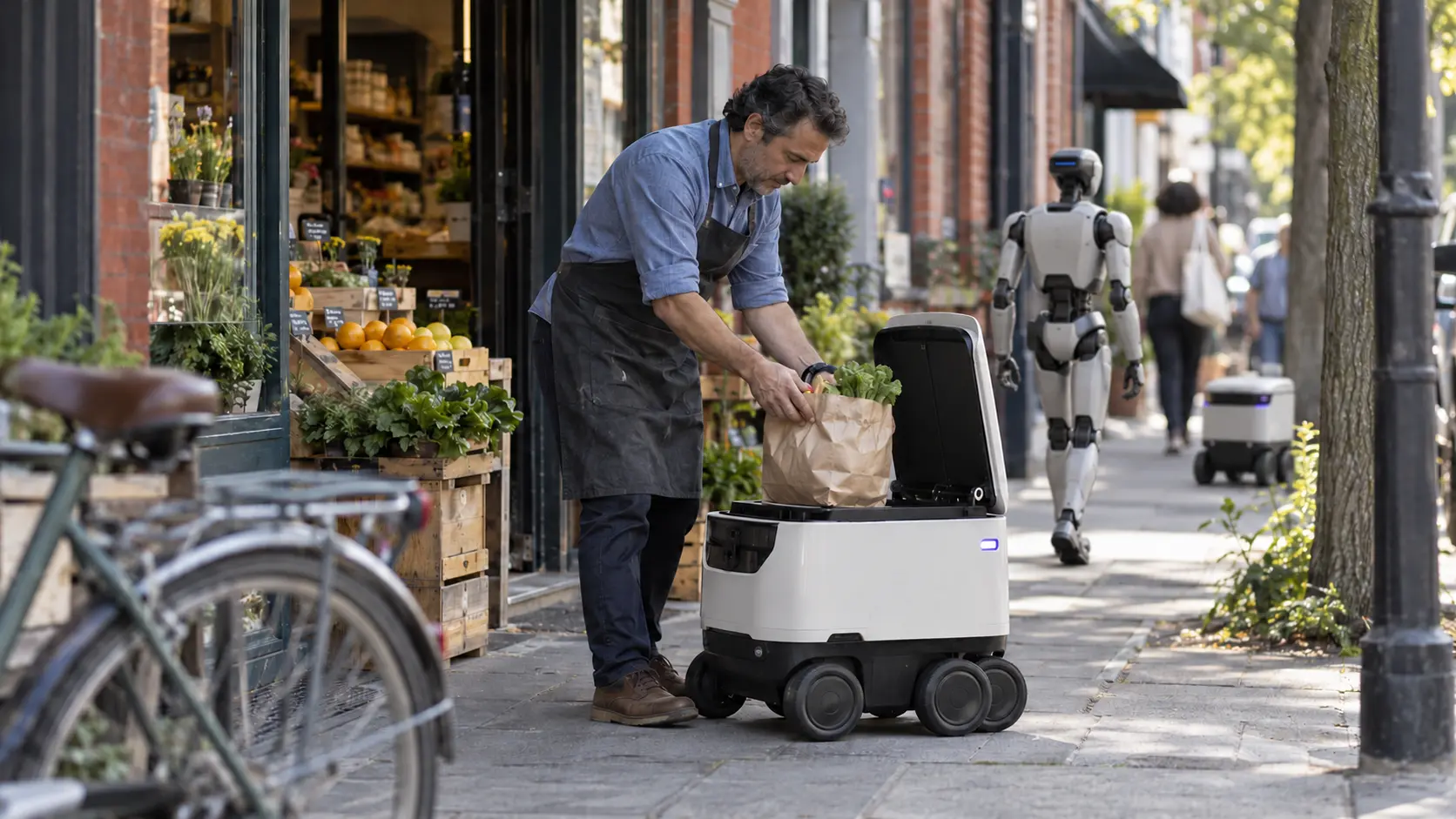
Imagine a farm owner who finally has six machines to help. Machines assist with transport, sorting, and handoffs, yet the owner keeps being asked to decide what happens next: a task awaits permission, a location has changed, another machine reports an exception. There are fewer crates to carry and more notifications to answer. If every device needs continuous attention, physical work may simply have become the work of managing machines.
That is the limit Part Three addresses. The number of machines can grow; one person's attention does not grow with it. Connecting someone to more equipment is a beginning. Useful cooperation must let the person remain in command of the work without watching it all the time.
We want machines to carry out more of the work, so people can focus on goals, choices, and change. The person understands why a customer wants a different arrangement. A machine reports what has happened on site. Each needs to correct the other's incomplete view and inform the next action. This is what Leptex means by people and robots understanding society together.
We use symbiotic AI to describe this vision: people set goals and retain decision authority, AI helps interpret needs and feedback from the site, and embodied machines carry out authorized tasks. Human experience can change a machine's plan; facts a machine brings back can help a person make a better judgment. Through that cooperation, we want to expand the range of action one person can reliably organize.
Master Plan, Part One learns about human needs through actual operations. Part Two carries confirmed conditions into machine execution. This chapter addresses changes that cannot all be written into a plan in advance: when that plan no longer fits, how do people and machines reconsider it together and carry a new decision into the work?
We would begin with speech, touch, and task feedback, then assess whether brain-computer interfaces (BCIs) offer useful new controls for different people and tasks. The specific approach would depend on the intended use, research evidence, and available partnerships. An interface can change how a choice is expressed; it cannot automatically expand human attention or supply missing machine capabilities. Leptex's foundation today remains personal intelligence software. Equipment coordination and BCIs here are future research and product proposals.
Connecting one person's intent to a team's actions
Return to the proposed farm setting. The owner wants to prioritize today's confirmed orders for which supply is available. Personal intelligence needs to understand what that means in this business: which orders qualify, which work can begin, and which arrangements still need confirmation. Those conditions do not disappear when input comes through a brain interface.
If future equipment and workflows have been validated, a system could coordinate within existing authorization: one machine transports checked crates, another performs sorting suited to its capabilities, and others wait for handoff in a designated area. The owner attends to goals, priorities, and exceptions. Each device's detailed movements remain the responsibility of an appropriately constrained control system.
Suppose a machine finds its route blocked. That change should return to the affected tasks. Work that can safely wait should wait; a change to a commitment should reach the person authorized to decide. When the system is unsure how to interpret a brain signal, it should likewise maintain an appropriate safe state, request confirmation, or offer another input method. An uncertain signal should not be presented as a settled decision.
The central task in this cooperation is to direct limited human attention toward decisions that need it. If the person must continuously decide how every wheel turns and every joint moves, attending to several machines becomes difficult. We want machines to carry out validated execution while making the overall work easier for a person to understand.
Information must also come back. People need to know what machines are doing, which tasks have not started, which results have been accepted, and where intervention is needed. Clear feedback matters as much as more natural input.
That asks more of a product than displaying every device in one place. A notification should explain which commitment is affected, which options have been checked, and what remains unknown. Work that is already authorized and safe to continue should avoid needless repeated confirmation. When a new decision is required, its consequences should be understandable. Details should remain available without making an owner inspect every machine repeatedly just to know whether the day is going to plan.
Understanding together requires mutual feedback
Follow the illustrative order from the earlier chapters and imagine the owner receives a call: the customer would like to collect tomorrow. Meanwhile, a robot finds that the intended storage location is occupied. The owner knows a customer need the machine has not yet learned; the machine reports a change the owner has not yet seen. Each has incomplete information that matters to the next step.
In the proposed workflow, the system would first present confirmed facts and conditions still needing a check. The owner would assess whether the fruit can be stored appropriately, whether space is available, and then confirm arrangements with the customer. The affected transport task would wait for a new decision, while unaffected work that can safely continue would proceed under its existing authorization. After the change, machines would return execution results so the owner could check what had been carried out.
The person's judgment changes in response to facts the machine brings back; the machine's tasks change in response to the person's new decision. This feedback helps an order adapt to circumstances the original plan did not anticipate. People and machines contribute different information, giving the next decision a clearer basis. That is the shared understanding we want to build.
There is a concrete way to check whether it happened. After the owner confirms the new arrangement, have affected tasks accepted it? Are unresolved changes visible? Could an old task still send the crate away? If the conversation changes but the work does not, cooperation has failed. Part Three aims to let people know, through changing conditions, what they decided and what machines actually accepted.
This requires systems to express uncertainty and missing knowledge. An owner should see which facts need checking, rather than receive a confident answer about something a sensor has not observed. After the owner makes a change, they also need to see which tasks have accepted it. Understanding together means feedback changes the work; it is more than displaying additional status information to a person.
We use understanding society to describe these observable cooperative behaviors, without equating them with human consciousness in a machine. A brain interface does not automatically merge human and machine thought. It may help a person express particular choices. Meaningful cooperation still depends on clear purposes, mutual feedback, appropriate authorization, and reliable execution.
What limits one person supervising six or seven machines?
One person coordinating six or seven robots is a possible research scenario. The number itself is not evidence of capability. Six machines operating dependably within clear limits may be easier to manage than two that constantly need correction. Different tasks, sites, and people may produce very different results.
One study used scalp recordings of brain activity to change the formation of ten small wheeled robots. The full BCI demonstration was performed by the paper's first author as a proof of principle. Coordinating a swarm's formation remains far from several robots independently carrying out complex production tasks. Robot swarm research
For an owner, the meaningful questions concern how long machines can work independently, how often they need intervention, what happens when several encounter problems at once, and the consequences of an error. Adding machines requires preserving the ability to allocate attention and maintaining appropriate safe states when a person cannot respond immediately.
Productivity should therefore be measured through work completed to the agreed standard. How many useful tasks does a person complete in the same working time? How much preparation, calibration, and correction is required? Does quality decline? Is total cost appropriate? These outcomes need comparison with the previous way of working. Six or seven robots do not automatically yield six or seven times the output, and new operating burdens should not consume the time recovered.
Our goal is to expand the range of work a person can reliably organize. Sometimes this means more completed tasks. Sometimes it means less fatigue or a new operating method for someone who found an existing tool difficult to use. Each deserves serious evaluation.
A question that stayed with us
During doctoral studies, Leptex's founder encountered research on using brain-computer interfaces to control drones and robots. That experience raised a lasting question: could a person use a wearable interface to direct actions beyond the reach of their own hands?
A research demonstration and a full day of practical work have different requirements. A drone may follow a command, but helping an owner work with machines also requires understanding why a task matters, what counts as completion, when to consult the person, and how to handle a changing environment. Connecting personal intelligence with embodied AI gives that earlier question a practical setting in which to be tested.
Published research provides an independent reference. In 2013, a University of Minnesota team reported an experiment in which five trained participants controlled a quadcopter in three-dimensional space using scalp electroencephalography (EEG) and motor imagery. Participants imagined movements, and the system recognized associated brain-activity patterns. The experiment demonstrated external-device control under specific training and task conditions, still far from interpreting arbitrary thoughts. Research paper
We want to bring that possibility back to daily life. When a person's hands are occupied, or an existing method of operation does not suit them, could there be another dependable way to participate? A technology's significance should be understood through the circumstances of the person using it.
From brain signals to useful choices
Brain-computer interfaces provide a technical path between brain activity and external systems. We are interested in how they could help people express operating intentions and work with AI and embodied machines. Approaches differ in how signals are acquired, whom they suit, and the conditions they require. The choice should follow the intended use and evidence from evaluation.
Scalp EEG research provides one concrete example: sensors record signals at the scalp, and systems identify patterns associated with particular intentions under specific training, task, and equipment conditions. Signal quality, calibration, effort required from the user, and errors still need careful work. These experiments offer evidence to learn from without defining the limits of BCI research.
Such an interface should not be understood as a complete reading of a person's thoughts. Selecting a target or expressing a preference among bounded choices presents a different problem from interpreting an unrestricted train of thought. For Leptex, a more testable starting point is to help a person make a few useful choices reliably, then assist with subsequent tasks in the context of known operating conditions.
In 2025, the University of California, Los Angeles (UCLA), described research combining a scalp-EEG-based BCI with an AI co-pilot. Brain signals and visual information supported cursor and robotic-arm tasks in a study with four participants. It suggests a division of work worth exploring: people express intent while AI assists execution. Results from a small study remain distinct from sustained reliability in daily operations. UCLA research overview
The interaction we envisage may also combine gaze, speech, or touch. Someone could look toward a task and make a selection in a way that suits them. Brain activity, eye movements, and muscle signals are different sources of information; products need to explain honestly what they use. Whether to include a signal should depend on whether it reduces effort, rather than whether it sounds futuristic.
Authority must remain with the person
As systems move closer to a person's intentions, authorization needs to become clearer. Inferring what someone might want remains different from their decision to permit an action now. A thought, a change in attention, or unstable brain activity should not directly authorize a payment, an external commitment, or a hazardous machine action.
In the products we hope to explore, owners would need to know which tasks may continue within established limits, which changes require confirmation, and how to cancel or take over. Equipment safety also needs independent protections. Emergency stopping cannot depend entirely on successful interpretation of brain signals. Input failure must have an understood fallback.
Personal signals also need clear limits on use. A signal provided to perform an operation should not be repurposed by default for advertising profiles, unrelated emotional judgments, or assessments of a person's worth. Exploration should begin by determining necessary data, where it is processed, retention periods, and how participation ends, while minimizing unnecessary collection of raw signals. These are requirements for future design, not a claim that today's product processes brain data.
Owners who choose not to use a BCI should retain other workable controls. Technology should expand participation, rather than turn new physical requirements or continuous measurement into a condition of work. Having a choice about whether to use an interface, when to use it, and how to stop extends the principle of personal intelligence into a new interface.
From one choice to a working day
An initial experiment could center on one useful choice: for example, which of two tasks with checked conditions should proceed first. Among the methods each participant can use, compare touch, voice, and a candidate brain interface for that same choice. Measure accuracy, preparation and calibration time, completion time, and fatigue. Recognition of an input would still need appropriate confirmation and authorization; it would not grant unrestricted control of equipment.
That experiment can answer a specific question: for which participants, under which conditions, does the new interface make this choice easier? For someone who has difficulty using their hands and for whom speech is also unsuitable, a dependable selection method could matter greatly. For someone who can comfortably press a button, the same device might add effort. Both findings should change product decisions.
The next test extends through time. After a demonstration, must the person train again the next day? Do movement, noise, fatigue, and environmental changes make a previously workable control difficult? One correct command is a moment within work. Preparation, setup, correction, withdrawal, and maintenance are all part of its cost.
Multiple-machine trials need to address coordination separately. As tasks increase, do interruptions, time needed for takeover, and the person's understanding of work remain acceptable? Cancellations, delays, lost connections, and simultaneous exceptions need defined handling. Good performance by a BCI on one choice cannot replace those system-level tests.
Research must also involve people with different physical conditions and experience, with a choice to withdraw. Any future medical use has its own validation and applicable requirements. This is a route for usability research, not a way to infer medical effectiveness from a business demonstration.
Continued investment should follow evidence that an operation is more useful for particular people and remains so across repeated use. If calibration and false activation consume the benefit, that interface direction should change or stop. Work on human goals, task feedback, and other useful controls can continue.
The part Leptex chooses to build
The capability Leptex wants to develop is personal intelligence that a person can understand and manage, connected to real work. We need to understand operating context, organize authorized tasks, present outcomes, and make intervention possible. BCI hardware, signal decoding, and robot control each require specialist capabilities; they are areas to explore with qualified partners.
Partnerships can help us focus, but they do not remove responsibility for the complete experience. An interface that recognizes input, a capable robot, and understandable software still need to be tested together. Pauses between components, inconsistent information, and awkward exception handling can all become costs borne by the owner.
The business should grow as its capabilities are validated. First demonstrate continued use of personal intelligence software, then test coordination with specific equipment, and finally assess whether an additional interface provides enough value. Hardware procurement, research, and on-site support require their own evaluation; partnership scope and investment should follow the results. If a particular brain interface falls short of practical requirements, software and coordination services that have already proved useful can continue to create value.
As these capabilities are validated, Leptex could connect owners' existing knowledge and choices to more ways of getting work done. Product experience can accumulate through better integration methods and clearer coordination, while personal information remains within its permitted scope. Growth should come from helping more people do real work.
The division of work must also survive practical comparison. If existing equipment and software already meet an owner's needs, Leptex should not add a management burden simply to occupy the interface. The value we seek is continuity between that person's operating goals, work arrangements, and feedback across tools. It must be judged over a complete working day, beyond an interface demonstration.
How should people live with greater capability?
The prospect we care about is a person who no longer has to perform every repeated action alone, yet still decides the direction of their work. Owners might spend more time tending crops, improving their craft, or serving customers. They might instead choose to reserve that time for family and life outside work. Productivity should include people's choices about their own time.
Wider effects also deserve attention. Access to equipment, maintenance capacity, connectivity, and training may determine who benefits first. We want optional interfaces, understandable workflows, and progressively lower delivery burdens to widen participation. The arrival of a technology does not establish that its benefits will be shared evenly.
The people in this cooperation also include workers on site, partners, and customers. Saving an owner's management time should not depend on imposing more interruptions, unclear responsibilities, or continuous monitoring on others. Changes to jobs, responsibility for training, and the distribution of gains need arrangements among participants. The social value of personal intelligence depends on more people gaining capability and choice, beyond the number of devices one manager can direct.
Over a longer horizon, human tools have extended perception, memory, and action. Brain-computer interfaces may become part of that process. Progress still needs to be judged by life as people experience it: whether more people can create, cooperate, and care for others; whether they can understand and refuse decisions affecting them; and whether greater capability preserves dignity and agency.
We look to the stars to imagine a more distant future, and to a person's working day to test it. An inquiry at a farm, a crate of fruit delivered, and an adjustment made through human-machine cooperation can each be a concrete step along that path. We want technology to respect that finite day and help the knowledge, work, and creativity within it reach further.
One master plan, returning time to people
The chapters connect a person's experience, action, and decisions. In Part One, artificial intelligence helps us understand the people in a business and make their experience useful when they are not present. In Part Two, embodied AI brings robots into work under clear conditions, connecting human decisions to dependable execution. In Part Three, symbiotic AI lets people and machines correct each other's understanding as circumstances change, keeping a wider range of action understandable and under human control.
We will judge progress at three stages: software someone chooses to keep using, physical work they can confidently delegate, and cooperation that makes change easier to manage. Each stage needs to create value on its own. If a more distant exploration stalls, capabilities already helping people should remain useful.
Return to the farmer at the beginning. They walk into the field while their experience continues helping customers. Once an arrangement is confirmed, suitable people and machines can carry it forward. When circumstances change, the farmer can see what needs a decision, have a new arrangement take effect, and return attention to the life in front of them. We want the three chapters to reach that ordinary, complete moment.
At the scale of the universe, a person's day is almost imperceptibly brief. For the person living it, that day is where care, work, creation, and choice take place. Our demand of technical progress is that more people can devote their limited time to what they value and gain the capability to make it happen.
That is the future Leptex wants to work toward: a person's knowledge can reach further, while that person still decides where to go.
Your personal intelligence. Built around your goals. Guided by your choices.
Continue reading: Master Plan, Part One · Master Plan, Part Two